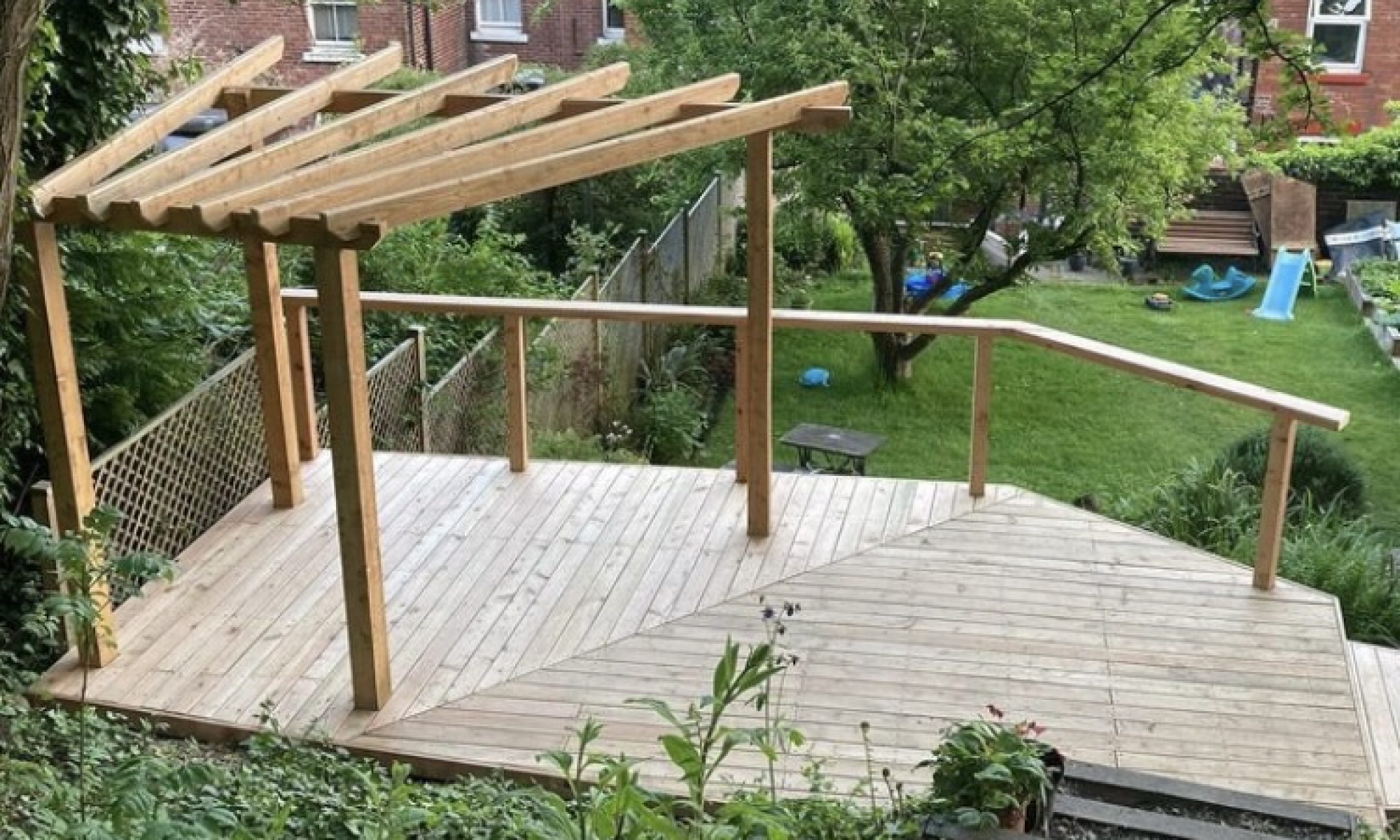

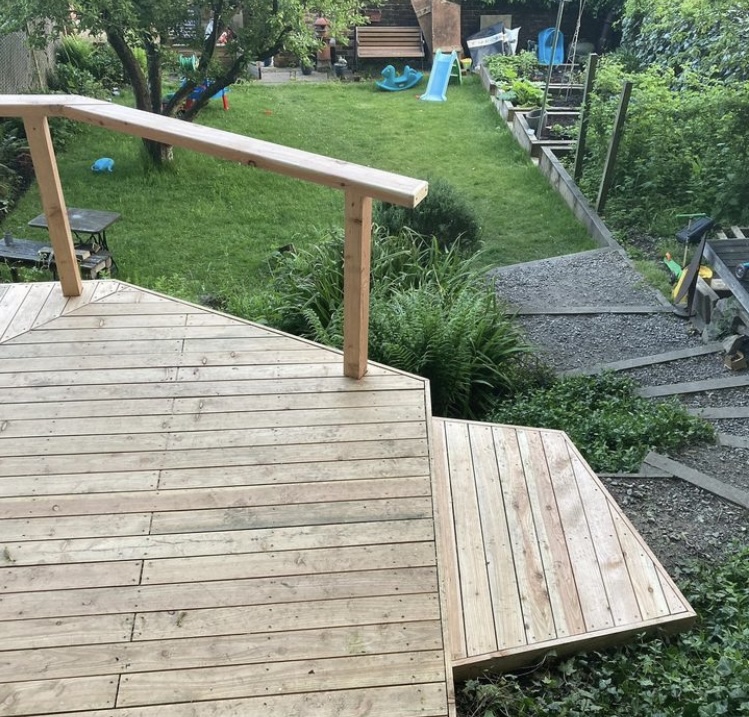
A decked area can help you make the most of your garden or yard. Along with my team, I can create exactly the space you want for your home. We install a range of high quality decking, in softwood, hardwood or composite. Following the design process including a topographical survey of the garden, we agree on the final design. I then work out and order the correct amount of materials, usually basing quantities on the 3D CAD file which ensures accuracy. It is the norm to over order with timber by 10%, to allow for imperfections in the material. That way your deck can look its very best.
We clear the area, and dig out where necessary to allow plenty of breathing space under the deck, so soil doesn’t make contact with the frame anywhere. A weed membrane is put down underneath where necessary. We set joists to 400mm, which gives plenty of strength in the structure, along with placing posts so the whole frame is really solid before the deck boards themselves are installed. Posts tend to be larch at a minimum so the frame will last the test of time. Postcrete or concrete is haunched around the posts so there is no chance of standing water around them, which is the primary cause of rot in the timber. If you have a bigger budget, these posts can be of steel construction, giving your decking an even longer life span. Standard treated pine 100mm square posts ought to last 15 years – larch twice that. Steel indefinitely.
The joists are constructed from 6×2 inch timber where room allows, which allows for loads of strength. This is particularly important when your deck is elevated above ground level – for example, at the back of a sloped garden (common in Sheffield) or out the back of your house where the garden slopes away down hill. I like to make my decks cantilevered where possible, so they have the appearance of floating above the ground. Balustrade posts are usually built into the framework, with the deck boards shaped around them. I can incorporate unusual shapes and even curves into the designs, though realising unusual shapes takes a bit longer.
Time is taken to cut the boards millimeter perfect. When it comes to the final touches with the deck boards, I allow for expansion or contraction of the timber by allowing at least 3mm between runs. If the boards are grooved on one side, I lay them with the groove side down. This minimises contact with the deck frame and gives more air flow, along with allowing water to channel down them – giving your deck as long as life as possible. This also gives more surface area on the top surface of the deck, so the boards are less slippy – though of course they will need regular cleaning to remain so. Many boards don’t have grooves at all, particularly those made from hardwood or composite, and this is absolutely fine! Finally we make sure all screws line through with each other. The details matter! You can then choose to oil your deck, though this is not advised straight away to allow the timber to breathe a bit first.
 Needham Design Ltd