
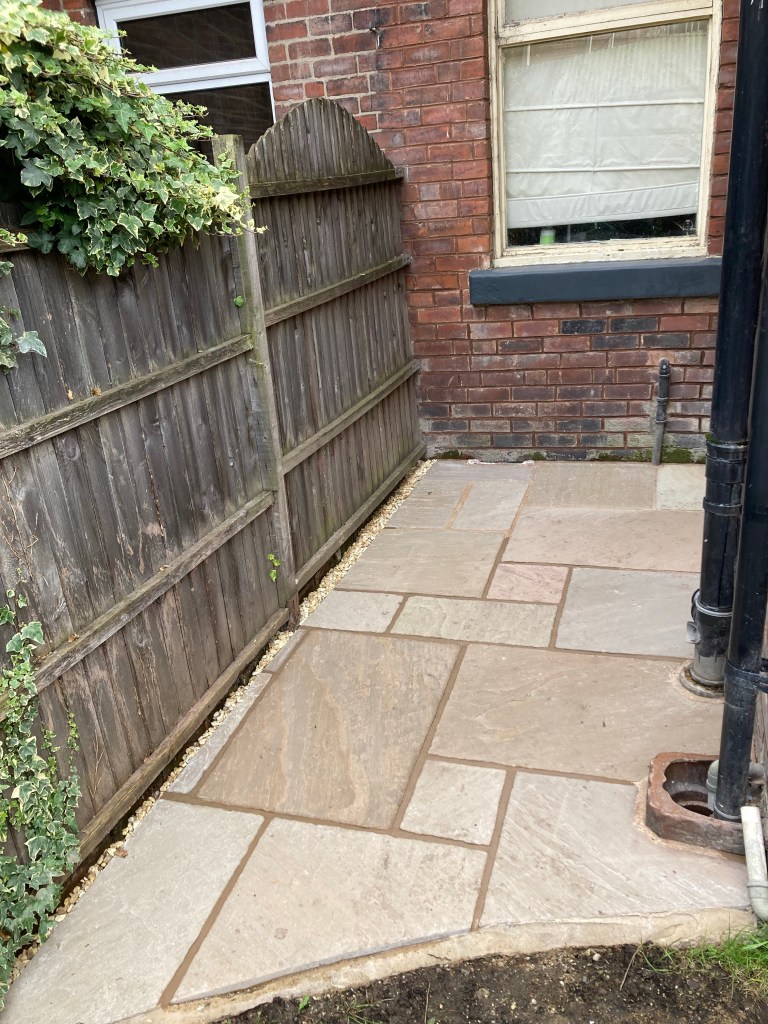
We are more than happy to install small to medium sized patios, and we make sure we do things properly. That means we will not be the cheapest when it comes to a patio, whether with flags, blocks or cobbles – but the results will be longer lasting and in my view well worth it.
Having agreed your design, along with material choices, we will dig out to sufficiently below the damp course of your house or building, if that is where the patio is going, taking special care around any services. We will then bring in 50 to 100mm of crusher, which will be whacker plated – that is to say compacted down. If necessary, slot drains will be installed, depending on the required fall of the patio. These are not needed if the patio can drain towards earth or grass within your garden. If if falls within the required patio area, your old drain cover will be removed and replaced with a recessed one which will blend in perfectly.
The patio will then be laid on a full mortar bed (typically 50mm thick), using an SBR slurry on the back of the flags. An appropriate volume of mortar for one flag is put down, this flag is carefully laid in the correct orientation and with the correct fall on it for drainage. This process is repeated for all flags until the patio area is finished. Any flags at the edges are cut accurately to size – to the millimeter – with a grinder. The patio then needs to be left for 24 hours without being walked on so the flags set, before they are pointed. The pointing varies based on the flags that are installed, whether concrete, Indian stone, limestone, slate or even Yorkshire stone. The edges of the patio are smoothly haunched with more mortar.
The process for laying cobbles is very similar. In the case of block paving, the blocks are laid on a compacted bed of screeded grit sand, rather than a mortar bed. Afterwards, kiln dried sand is brushed into the gaps.
Your patio can then be sealed with a variety of products, if the stone in question requires.
 Needham Design Ltd